
JOIN OUR MAILING LIST
JULY 2026 PROGRAMS
FROM THE MEDITERRANEAN TO THE NORTHERN LIGHTS: JEWISH JOURNEYS TOGETHER
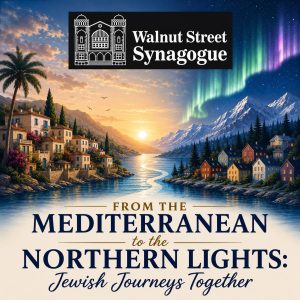
Jewish Norway Tour
Thursday, July 9, 12:00 pm ET
The Jewish presence in Norway began in the mid-19th century, after the repeal of the 1814 constitution’s “Jew Clause” in 1851 — a change driven by poet and activist Henrik Wergeland. Early Jewish settlers, many from Eastern Europe and Denmark, established communities in cities such as Trondheim and Oslo. The Trondheim synagogue, once a train station, stands as a symbol of survival and adaptation. During the Holocaust, over a third of Norwegian Jews were deported and murdered, leaving deep scars on both cities’ communities. Post-war years saw a gradual rebuilding of Jewish life, balancing tradition with the realities of modern Norwegian society. Today, Trondheim and Oslo reflect a blend of resilience, migration, and living heritage.
Our guide, Louise Kahn, is a Norwegian-born Jewish social entrepreneur, cultural organizer, and civic leader focused on strengthening Jewish identity and dialogue in Europe. Born and raised in Norway in a Jewish family with strong Zionist roots, she later moved to Israel, where she has been based since young adulthood. Kahn is the founder of Kos & Kaos, a Nordic Jewish network that creates platforms for open conversation, intellectual exchange, and community-building around issues such as antisemitism, identity, and the public discourse surrounding Israel. She is also the founder of Compass North, an initiative focused on connecting Nordic Jewish voices, fostering cross-border collaboration, and addressing contemporary challenges facing Jewish communities in Northern Europe. Through roundtables, debates, and cultural programming, her work aims to counter polarization and create space for nuanced, inclusive dialogue. In parallel, Kahn works as a UX/UI designer and front-end developer, combining her tech background with her role as a public thinker and community builder. Her work sits at the intersection of identity, technology, and civic engagement, with a particular focus on amplifying underrepresented perspectives and strengthening Jewish communal resilience in Europe.
Learn more about the series here
CSP
The Walnut Street Synagogue is pleased to be a partner congregation of the Orange County Jewish Community Scholar Program. Please join us at an upcoming program!
Unlocking the Jewishness of William Kentridge
Part 1 – The Pull of Gravity – Tuesday, July 21, 1:00 pm ET (online)
Part 2 – Tide Table – Tuesday, July 28, 1:00 pm ET (online)
Part 3 – Kentridge in Conversation – Tuesday, August 4, 1:00 pm ET (online)
(online in partnership with the Orange County Jewish Community Scholar Program)
South African superstar William Kentridge is one of the top contemporary artists in the world today, acclaimed internationally, but the Jewishness of his life and work is rarely discussed. Within cultural circles he is considered the peer of David Hockney, and occasionally they explore similar territory (although with utterly different aesthetics). His drawings, tapestries, sculptures and installations are exhibited at the best art galleries in the world, his prize-winning series of animations receive rave reviews whenever shown and he is also an opera set designer and director, his production of Orfeo is currently selling out Glyndebourne, the UK’s premiere opera venue. The son of Nelson Mandela’s lawyer, he brings together the worlds of post-apartheid South Africa and Lithuanian Jewish memory, weaving themes from Jewish texts, ritual, and tradition into work that explores identity, history, and belonging. In this series, in addition to our transatlantic learning between London and California, we will travel from Johannesburg to Lithuania to Rome, exploring how Kentridge’s Jewish heritage informs his artistic thinking. The series will culminate with an online conversation with the artist himself.
Part 1 – The Pull of Gravity – In this session we’ll explore Kentridge’s biography and how his life has shaped his work. We’ll do a close reading of some of his international drawing and sculpture installations and think about his theatrical and operatic work too, “unlocking” the Jewishness of his thinking and creative process as we explore his incredible imagination and aesthetic. We’ll also learn about some of the collaborators who have helped him build a Kentridgian world of shape and sound.
Part 2 – Tide Table – William Kentridge is probably most famous for his animations; a series of black and white short films built across decades which unpick South Africa’s history and politics. In today’s session we’ll learn how they developed, the controversies around their portrayals of South African Jewish identity and closely read one of the series, Tide Table (2003), to champion him as an important, if complicated, Jewish political and artistic voice.
Part 3 – Kentridge in Conversation -Over the course of our learning journey, Aviva Dautch has drawn on extensive time she spent with Kentridge in his Johannesburg studio, as well as interviews with colleagues and collaborators who have helped illuminate his life, work, and artistic vision. Now, after exploring the themes, influences, and historical contexts that shape his extraordinary career, we will have the rare opportunity to hear directly from one of the world’s most acclaimed contemporary artists. Join us as Aviva and William Kentridge reflect on art, memory, Jewish identity, South Africa, and the creative process – and bring your own questions for what promises to be a fascinating and memorable conversation.
Dr. Aviva Dautch is the Executive Director of Jewish Renaissance, the UK’s quarterly Jewish arts magazine and the leading English-language Jewish cultural publication in Europe. She is an academic in the field of Jewish literature: her PhD received Royal Holloway’s Reid Scholarship and a research award from Brandeis University, and she is a Fellow of the Higher Education Academy. During the academic year 2025-2026 Aviva will be the first ever Scholar-in-Residence for the University of Oxford’s Vera Fine Grodzinski Jewish Women’s Voices program at the Oxford Centre for Life Writing. Aviva frequently lectures on modern Jewish culture at the London School of Jewish Studies, JW3 Community Centre and Limmud. She has worked as a curator, producer and educator for many of the major London arts institutions, including the British Library, the British Museum, Bethlem Museum of the Mind, The Royal Academy and Tate Modern. Aviva is also an award-winning poet and a regular arts broadcaster for BBC Radio 4.
Part 1 – Program video
Part 2 – Program video
The Dead Sea Scrolls: A New Vantage Point on Judaism in Antiquity
Part 1 – The Dead Sea Scrolls – A new light on the sacred Priestley library found in Qumran – Sunday, July 5, 1:00 pm ET (online)
Part 2 – The Four-fold Division of the Priestly Library – Sunday, July 12, 1:00 pm ET (online)
Part 3 – The struggle on the Calendar: Holy Place, Holy Time, Holy Liturgy, Holy Memory – Sunday, July 19, 1:00 pm ET (online)
Part 4 – Pharisees and Sadducees: Oral Authority or a Written Authority? – Sunday, July 26, 1:00 pm ET (online)
(online in partnership with the Orange County Jewish Community Scholar Program)
The unexpected finding of the Dead Sea Scrolls between 1947-1956 shed a new light on Jewish history in antiquity. Their final authoritative bilingual editions in Hebrew and in English or in Aramaic and in French or English became available only in the last few decades. All the unknown Hebrew and Aramaic manuscripts written on parchment, are a part of a priestly sacred library of authors who describe themselves as “The priests the sons of Zadok and their allies”. In this series we’ll discuss the four fold nature of the unknown books, the background of their authors and their purpose, the historical background of their writing in the two last centuries BCE in relation to the bitter dispute on the priestly calendar, and the connection of the scrolls to the ongoing conflict between the Pharisees and the Sadducees.
Rachel Elior is the John and Golda Cohen Professor Emerita of Jewish Philosophy and Jewish Mystical Thought at the Hebrew University of Jerusalem, where she taught for decades and twice served as Chair of the Department of Jewish Thought. A leading scholar of Jewish mysticism and the Dead Sea Scrolls, her research spans early Jewish mystical traditions, Heikhalot literature, Kabbalah, Hasidism, Messianism, Sabbatianism, and the place of women, slavery, and freedom in Jewish culture and religious history. Prof. Elior is the author of 20 books and more than 120 scholarly articles, with works translated into multiple languages. Among her books are The Unknown History of Jewish Women, Israel Ba’al Shem Tov and His Contemporaries, and The Three Temples: On the Emergence of Jewish Mysticism. Her scholarship has received numerous honors, including the Gershom Scholem Prize for Research in Kabbalah and an honorary doctorate from Hebrew Union College.
Part 1 – Program video
Part 2 – Program video
Part 3 – Program video
Part 4 – Program video
What Has Rome to Do with Jerusalem?
Tuesday, July 23, 1:00 pm ET (online)
(online in partnership with the Orange County Jewish Community Scholar Program)
When the First Jewish Revolt ended in 70 CE, the destruction of the Second Temple marked a turning point not just in Jewish history, but in Roman imperial identity. This lecture examines how the Flavian dynasty turned their conquest of Judea into imperial propaganda, from the Arch of Titus to coinage proclaiming Judaea Capta. We’ll explore how Rome used Jewish defeat to define its own triumph, and how the Jews, in turn, transformed catastrophe into spiritual resilience and renewal.
Professor Jodi Magness is a leading expert in archaeology and Jewish history, specializing in the Roman, Byzantine, and early Islamic periods in the Land of Israel. She is the Kenan Distinguished Professor for Teaching Excellence at the University of North Carolina at Chapel Hill, where she has taught since 2002. Prof. Magness’ research focuses on topics like ancient synagogues, the Dead Sea Scrolls, and Roman- era Jerusalem. She has authored several award-winning books, including Masada: From Jewish Revolt to Modern Myth and The Archaeology of Qumran and the Dead Sea Scrolls, and is a frequent contributor to scholarly journals. Prof. Magness has directed numerous excavations in Israel, including the famous Roman siege works at Masada and the ongoing excavations at Huqoq in Galilee. Her work has earned her prestigious awards, such as the 2025 Martha and Artemis Joukowsky Distinguished Service Award from the Archaeological Institute of America. Prof. Magness has also been featured in documentaries, including Jerusalem (2013) and The Story of God with Morgan Freeman (2016). A dedicated educator, she has created popular courses on the archaeology of the Holy Land, available through The Great Courses. In addition to her academic accomplishments, Prof. Magness has held leadership roles in organizations such as the Archaeological Institute of America and the American School of Classical Studies at Athens. She is an Honorary President of the AIA and continues to influence the field of archaeology
The New Syria – New Enemy or New Friend
Tuesday, July 14, 3:30 pm ET (online)
(online in partnership with the Orange County Jewish Community Scholar Program)
Syria is one of the most consequential and least understood countries in the Middle East, and few Western Jews have had the opportunity to witness its dramatic transformation from the inside. Join Rabbi Asher Lopatin for a fascinating firsthand account of his groundbreaking visits to Syria in 2025, beginning just months after the fall of the Assad regime and continuing through two subsequent missions. Rabbi Lopatin will share the remarkable story of how these journeys came about, what he encountered on the ground, and whether a new chapter in Syria’s relationship with the West, and perhaps even with Israel, may be possible. Drawing on candid conversations with government officials, business leaders, educators, cultural figures, and ordinary Syrians from all walks of life, he will offer a rare glimpse into a country long viewed as one of Israel’s most implacable adversaries. Combining personal stories, political insight, and on-the-ground observations, this promises to be an extraordinary look inside a nation at a historic crossroads.
Rabbi Asher Lopatin is the rabbi of Kehillat Etz Chayim in Detroit and the Director of Community Relations at the Jewish Federation of Greater Ann Arbor. He is a Rhodes Scholar with an M.Phil in Medieval Arabic Thought from Oxford University. He has rabbinic ordination from Rav Ahron Soloveichik and Yeshiva University and is a permanent member of the Council on Foreign Relations. Rabbi Lopatin is married to Rachel Tessler Lopatin and they have four children.
Program video
Reality and Imagination: Rembrandt and the Jews in the Dutch Republic
Tuesday, July 7, 3:30 pm ET (online)
(online in partnership with the Orange County Jewish Community Scholar Program)
Join curator Prof Michael Zell and co-curator Simona Di Nepi for a virtual tour of the exhibition Rembrandt and the Jews in the Dutch Republic currently on view at the Museum of Fine Arts Boston (MFA). In the 17th century, Jews played a critical role in the vibrant visual culture of the Dutch Republic—as patrons, collectors, and subjects of art, particularly in the work of Rembrandt van Rijn (1606–1669) and his circle. Living in the heart of Amsterdam’s Jewish district, Rembrandt received commissions from his Jewish neighbors, incorporated them into biblical scenes, and depicted them in character studies.
Michael Zell is Professor of History of Art and Architecture at Boston University. He has published widely on seventeenth-century Dutch artistic culture, with a particular focus on Rembrandt and Vermeer. He is the author of Reframing Rembrandt: Jews and the Christian Image in Seventeenth-Century Amsterdam (2002) and Rembrandt, Vermeer, and the Gift in Seventeenth-Century Dutch Art (2021), as well as co-editor with Alan Chong of Rethinking Rembrandt (2002). In addition to co-curating with Simona Di Nepi the MFA exhibition Reality and Imagination: Rembrandt and the Jews in the Dutch Republic, he was co-curator with Jospeh Koerner of the exhibition Lifeworld: Portrait and Landscape in Netherlandish Prints, 1550–1650 at the Harvard Art Museums (1999–2000).
Simona Di Nepi is the Charles and Lynn Schusterman Curator of Judaica at the Museum of Fine Arts, Boston, where she is responsible for building and displaying the Judaica collection, and for curating Intentional Beauty: Jewish Ritual Art from the Collection, the museum’s first Judaica gallery.
Program video
COMMUNITY PARTNER PROGRAMS
Jewish Stories of Revere Beach
Sunday, July 26, 3:00 – 5:00 pm ET
(in-person program presented by the Wyner Family Jewish Heritage Center at American Ancestors at Rumney Marsh Academy, 140 American Legion Hwy #3, Revere) NEW LOCATION

Take a trip back in time to celebrate summers at Revere Beach! Join the Wyner Family Jewish Heritage Center in Revere for an afternoon of stories, conversation, and history of the Jewish summer community in Revere Beach. This lively event will feature a discussion about the popularity of Revere Beach as a summer destination for the Greater Boston Jewish community in the mid 20th century, opportunities for participants to share memories, and a kosher ice cream social. Space is limited. Advance registration is required.
YAD CHESSED

Yad Chessed helps Jewish individuals and families who struggle with financial hardship pay their bills and buy food. As a social services agency rooted in the Jewish values of kindness (chessed) and charity (tzedakah), they are committed to helping those in need navigate a path toward financial stability while preserving their privacy and dignity. They provide emergency financial assistance, grocery gift cards and compassionate advice for those trying to make ends meet. Hundreds of families and individuals throughout the state rely on Yad Chessed to provide for their essentials, and even at times, a Jewish burial for a loved one. Members of our community, as well as others in the Jewish community, who need assistance may contact Yad Chessed by phone at 781-487-2693 or by Email at intake@yadchessed.org for a confidential conversation. Questions can be directed to info@yadchessed.org.
Support Yad Chessed