
JOIN OUR MAILING LIST
APRIL 2026 PROGRAMS
IDEALS OF FREEDOM: JEWISH IMMIGRATION, ARTS AND ADVOCACY IN AMERICA
From Synagogue to Museum: The Journey of a Jewish Immigrant Woodcarver and His Torah Arks
Wednesday, April 15, 7:00 pm ET RESCHEDULED FOR MAY 27
Torah arks and furnishings by immigrant woodworker Sam Katz once graced numerous synagogues in New England and beyond. One of his largest surviving works remain in Chelsea’s Walnut Street Synagogue. Simona Di Nepi, Charles and Lynn Schusterman Curator of Judaica at the Museum of Fine Arts, Boston, will tell the behind-the-scenes stories of two works by this artist in the museum’s collection, from the acquisition of a mysterious gilded lion 65 years ago, to the recent display of a rescued Torah Ark from Chelsea and its transformation into the focus point of the MFA’s Judaica gallery. The presentation will also highlight other works by American Jewish immigrant artists represented in the gallery.
Simona Di Nepi is the Charles and Lynn Schusterman Curator of Judaica at the Museum of Fine Arts (MFA), Boston, where she is responsible for building and displaying the Judaica collection, and for curating ‘Intentional Beauty: Jewish Ritual Art from the Collection,’ the museum’s first Judaica gallery. Originally from Rome, before moving to the United States, Simona studied and worked in London and Tel Aviv for 25 years. She filled curatorial roles, in both decorative arts and Old Masters, at the Victoria and Albert Museum, The National Gallery and the Royal Academy of Arts in London, where she cared for permanent collections and curated exhibitions. In Israel, she worked as curator at Anu: The Museum of the Jewish People and as a Lecturer in Italian Renaissance Art at Reichman University, Herzliya. Simona curated the exhibitions and wrote the accompanying publications for “Reunions: Bringing Early Italians Paintings Back Together” (The National Gallery, London, 2005), and “Dreyfus: The Story of a French-Jewish Family” (Anu: the Museum of the Jewish People, Tel Aviv, 2014). She is also the author of the National Gallery’s collection catalogue From ‘Duccio to Leonardo: Renaissance Painting 1250-1500.’ In Judaica, Simona wrote the essays “Itinerant Sephardic Judaica: from Dutch Ports to the Harbours of Europe and the Americas,” “Jewish Things at the Museum of Fine Arts: a History,” “The Servi Shaddai: the Family History of an amulet at the MFA Boston,” and “Treasures from storage: Two Rediscovered Italian Jewish Textiles.” Simona is guiding Boston University students in the development of “Real and Imagined: Rembrandt and the Jews of the 17th-Century Dutch Republic,” an in-focus MFA exhibition that opens in December 2025. Session partners – Wyner Family Jewish Heritage Center at American Ancestors, Massachusetts Antisemitism Synagogue Task Force (MAST), Orange County Jewish Community Scholar Program (CSP)
Learn more about the series here
CSP
The Walnut Street Synagogue is pleased to be a partner congregation of the Orange County Jewish Community Scholar Program. Please join us at an upcoming program!
From Challah to the Table – Jewish Food as Cultural Memory
Tuesday, April 28, 1:00 pm ET (online)
(online in partnership with the Orange County Jewish Community Scholar Program)
This engaging talk explores challah not simply as bread, but as a powerful symbol of Jewish memory, identity, and connection across time and place. Blending personal childhood stories with ancient texts, global Jewish history, contemporary art, and moving examples from communities around the world, the presentation shows how food, and challah in particular, becomes a living bridge between generations, between diaspora and homeland, and between cherished tradition and creative renewal
Merav Oren is a multidisciplinary entrepreneur, cultural curator, and a leading voice in Israel’s culinary-cultural world. A veteran of the FoodTech and AgriTech sectors, she has spent more than 30 years building ventures at the intersection of food, innovation, design, and community. She is the Founder and CEO of FOODISH, ANU Museum of the Jewish People’s culinary initiative, and now leads FOODISH Global, using food as a powerful medium for Jewish memory, identity, and community.
Program video
The Holocaust – A History of Decisions, Places, and Moral Collapse
Part 5 – Sunday, April 5, 1:00 pm ET (online)
Part 6 – Sunday, April 12, 1:00 pm ET (online)
Part 7 – Sunday, April 19, 1:00 pm ET (online)
Part 8 – Sunday, April 26, 1:00 pm ET (online) RESCHEDULED FOR MAY 6
(online in partnership with the Orange County Jewish Community Scholar Program)
In this powerful eight-part series, Prof. Stephen Berk guides us through the Holocaust, not as a single, inevitable catastrophe, but as a series of historical choices made by governments, institutions, communities, and individuals across Europe. Moving chronologically and geographically, the series explores how the “oldest hatred” was transformed into state-sponsored genocide, how different countries responded to Nazi pressure, and how moments of action, or inaction, shaped the fate of millions. With clarity, moral seriousness, and historical depth, Prof. Berk helps us understand not only what happened, but how it happened, and why those lessons still matter.
Stephen M. Berk, who served as CSP’s 10th Annual One Month Scholar in Residence in February 2011, is Professor of History at Union College in Schenectady, New York, former Chair of the Department of History, Director of the Program in Russian and Eastern European Studies and Faculty Advisor to the Jewish Student Organization. He is the author of Year of Crisis, Year of Hope: Russian Jewry and the Pogroms of 1881-1882 (Greenwood Press, 1985). He is currently writing a book titled: Our People Are Your People: American Jewry and the Struggle for Civil Rights 1954-1965. The book provides an interesting discussion of an extremely important chapter in the history of the civil rights movement and attempts to dispel the myths and misunderstandings surrounding the Black-Jewish relationship. A recipient of the Citizens Laureate Award of the University of Albany Foundation, Professor Berk has been a consultant to the Wiesenthal Holocaust Center in Los Angeles, has written articles on Russian and Jewish history, anti-Semitism, and the Middle East and has lectured on throughout the United States and Canada including such distinguished colleges and universities as Princeton, Vanderbilt, The University of Texas at Austin and Williams College.
Part 5 – Program video
Part 6 – Program video
Part 7 – Program video
Photographs, Memory, and Torn Landscapes – Israeli Artists Responding to October 7th
Tuesday, April 21, 1:00 pm ET (online)
(online in partnership with the Orange County Jewish Community Scholar Program)
To mark Israel’s Memorial Day and Independence Day, join a powerful lecture exploring how Israeli artists responded in real time to the trauma and aftermath of October 7, 2023, with special attention to a project that birthed the traveling exhibition and book Album Darom and its 2024 presentation in Los Angeles. Beginning with a remarkable series of daily Facebook posts launched by scholar and photographer Prof. Dana Arieli on October 20, 2023, this session will trace a visual record of the Western Negev through historical photographs, contemporary artistic projects, and deeply immediate images of life during and after the attacks. Bringing together the work of renowned photographers and ordinary people alike, these images capture fear, resilience, memory, beauty, interruption, and survival, revealing how photography became a way to witness, process, and preserve a shattered world.
Dr. Rotem Rozental is the Executive Director and Chief Curator of the Los Angeles Center of Photography, formerly Chief Curator at American Jewish University, and a lecturer at USC Roski. A scholar of photo-based art and visual culture, she authored Pre-State Photographic Archives and the Zionist Movement (Routledge, 2023), winner of the AJS Jordan Schnitzer First Book Award, and has written widely for Artforum, Photographies, Jewish Currents, Tablet and Forward. She mentors artists globally, edits and contributes to artist books and is currently developing a nonfiction memoir.
Program video
Legends of Leisure – The Golden Era of the Borscht Belt Resorts
Thursday, April 16, 3:30 pm ET (online)
(online in partnership with the Orange County Jewish Community Scholar Program)
Join us for a virtual tour led by Dr. Sharon Keller exploring the Catskills Borscht Belt Museum in Ellenville, New York, a lively tribute to the storied resort world that once drew generations of mostly Jewish vacationers to the mountains of upstate New York. Through photographs, recreated spaces, memorabilia, and exhibitions that spotlight the food, comedy, and social life of the Borscht Belt, the museum preserves the spirit of an era that helped shape American Jewish culture and popular entertainment. Along the way, colorful figures like Morris Katz, the famed quick-painting entertainer of the Catskills hotels, help bring to life the creativity, humor, and larger-than-life personality that made this world so memorable.
Dr. Sharon Keller, CSP’s 15th Annual One-Month Scholar in Residence (January 2016) and the recipient of the 5th Annual CSP Maimonides Award for Excellence in Jewish Education. is a captivating and unconventional educator who brings the ancient world to life. With a PhD in Hebrew and Judaic Studies from NYU—where she specialized in the Bible and the Ancient Near East—Dr. Keller has held faculty positions at the Jewish Theological Seminary, Hebrew Union College, NYU, and Hunter College. She currently teaches in the Comparative Literature Department at Hofstra University, where she continues to explore the ancient Mediterranean through courses on biblical literature, Egyptology, and archaeology.
The “Redemptive ” Antisemitism of the Nazi Period
Tuesday, April 14, 1:00 pm ET (online)
(online in partnership with the Orange County Jewish Community Scholar Program)
What made Nazi antisemitism different from earlier forms of hatred, and how did it become the driving force behind the Holocaust? In this compelling lecture, we will examine the rise of antisemitism in Germany between 1933 and 1945, exploring not only the events themselves but the radical ideology that fueled them. Drawing on Saul Friedländer’s powerful concept of “redemptive antisemitism,” this session will show how Nazi thinking cast Jews not simply as enemies, but as a poisonous force whose removal was imagined as a form of national purification. By probing the motives, ideas, and moral collapse at the heart of the Nazi project, we will confront the disturbing question of how such a doctrine could take hold in one of Europe’s most cultured societies and where, within that process, the Holocaust became tragically imaginable.
Originally from London, Dr. Katherine Aron-Beller is a Senior Lecturer in Jewish History at the Hebrew University’s Rothberg International School and a Senior Research Fellow at Tel Aviv University. An expert in the history of antisemitism, medieval and early modern Jewish history, Jewish-Christian relations, and the Papal Inquisition, she is the author and editor of several major works, including “Jews on Trial and Christian Images and their Jewish Desecrators.” She has also led Jewish historical tours throughout Europe, including Greece, Italy, Spain, Portugal, and the United Kingdom.
Program video
Seder Night With My Ancestors – From Marjorie Morningstar to Chava Alberstein
Tuesday, April 7, 1:00 pm ET (online)
(online in partnership with the Orange County Jewish Community Scholar Program)
Step into Pesach through the voices of modern Jewish writers in a lively and thought-provoking session that brings the holiday’s stories, themes, and celebrations to fresh literary life. Together we’ll explore powerful Israeli poems and songs by Yehuda Amichai and Chava Alberstein in Hebrew and translation, alongside evocative English-language works by writers such as Joanne Limburg, Marge Piercy, and Isaac Rosenberg. Along the way, we’ll also savor the wit, warmth, and occasional chaos of memorable literary seders in the fiction of Michael Chabon and Herman Wouk, discovering how modern Jewish literature captures both the depth and the delight of the Passover experience.
Dr. Aviva Dautch is the Executive Director of Jewish Renaissance, the United Kingdom’s quarterly Jewish arts magazine and the leading English-language Jewish cultural publication in Europe. She is an academic in the field of Jewish literature: her PhD received Royal Holloway’s Reid Scholarship and a research award from Brandeis University, and she is a Fellow of the Higher Education Academy. Aviva frequently lectures on modern Jewish culture at the London School of Jewish Studies, JW3 Community Centre and Limmud. She has worked as a curator, producer and educator for many of the major London arts institutions, including the British Library, the British Museum, The Royal Academy and Tate Modern. Aviva is also an award-winning poet and a regular arts broadcaster for BBC Radio 4.
Program video
COMMUNITY PARTNER PROGRAMS
In Conversation with Oren Jacobson on Public Discourse and Antisemitism
Thursday, April 30, 12:00 pm ET
(online program presented by Combined Jewish Philanthropies)
CJP’s President and CEO Rabbi Marc Baker will be in conversation with Oren Jacobson, founder and CEO of Project Shema, for a thoughtful, timely conversation exploring how antisemitism operates, why rhetoric matters, and what it will take to hold the complexity a pluralistic society requires.
Nachum Kaplan Discussing China, Israel and Antisemitism
Sunday, April 26, 8:00 pm ET
(online program presented by the Massachusetts Antisemitism Task Force)
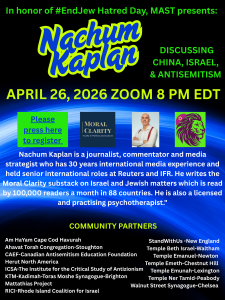
Join Nachum Kaplan for a timely conversation on China, Israel and antisemitism. Kaplan has spent 30 years working as a journalist, commentator, speaker, and C-suite media strategist to Fortune 500 companies. He has senior editorial positions and helped set the strategic direction in some of the world’s leading newsrooms, including Reuters and International Financing Review and he writes a Substack column with a readership from 87 countries.
Declarations of Americanism: Jewish-American Displays of National Identity
Thursday, April 16, 4:00 pm ET
(online program presented by the Wyner Family Jewish Heritage Center at American Ancestors)
As we commemorate the 250th anniversary of the American Revolution, questions of national identity and democratic commitment are top of mind. Jewish Americans have long grappled with these topics, navigating assimilation while encountering suspicions of dual loyalties. With the dramatic rise of immigration in the late 19th century, Jewish immigrant communities encountered heightened pressures and possibilities to exhibit American identity. In this talk, Jewish Heritage Center (JHC) Historian in Residence Madeline DeDe-Panken considers why Jews leaned into American iconography throughout the 19th and early 20th century and how such displays shaped Jewish life in America. Madeline DeDe-Panken is a historian with broad interests in culture, gender and public knowledge. Her current research explores the rise of popular mycology at the turn of the twentieth century. Madeline has multifaceted experience in museums and non-profits, having held fellowships at institutions including the Schlesinger Library, Massachusetts Historical Society, and the Center for Women’s History at the New-York Historical Society.
YAD CHESSED

As Passover approaches, we all have the opportunity to fulfill the beautiful mitzvah of Maot Chittim (“wheat money”) by making a donation to Yad Chessed to ensure that every member of our community can afford food and joyfully celebrate this cherished holiday. Maot Chittim is a mitzvah which dates to ancient times when individuals would contribute funds so that everyone in their community could afford the necessary provisions for the Passover holiday. Yad Chessed, an organization focused solely on assisting Jews in our community currently struggling with financial hardship and food insecurity, is committed to upholding this tradition by helping families purchase food on Passover. Your generous donation will contribute to ensuring that no one is left behind during this special time of year. By giving to Yad Chessed, you are not only fulfilling a fundamental mitzvah but also spreading hope, joy, and unity throughout our community. And, if you know of someone in our community who is struggling with financial challenges, please encourage them to reach out to Yad Chessed for assistance. Together, we can make a significant difference in the lives of those who need it most.
Support Yad Chessed