
JOIN OUR MAILING LIST
DECEMBER 2025 PROGRAMS
CHANUKAH
Chelsea Public Menorah Lighting
Monday, December 15, 5:00 pm ET (in person at Chelsea Square)
(hosted by Tobin Bridge Chabad and the City of Chelsea in partnership with the Walnut Street Synagogue and Temple Emmanuel)
Join us for the ninth annual Chelsea Chanukah celebration in Chelsea Square (Winnisimmet Park on Broadway between Second and Williams Streets in front of the Chelsea Police Station) as we light the giant menorah and celebrate Chanukah as a community with music, latkes, doughnuts and swag.
More information
WALKABOUT TEL AVIV: TEL TO TOWERS
Markets & Migrations: A Taste of Tel Aviv
December 3, 7:00 pm ET
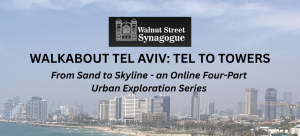
They say you can’t truly know a city until you taste it—and Tel Aviv proves that food is its most eloquent storyteller. In this flavorful finale, we’ll explore how immigration, innovation, and cultural fusion have created a vibrant culinary mosaic. Our journey begins in Sarona Market, a sleek food hall nestled within the restored buildings of the German Templar colony of Sarona. Here, we’ll trace the legacy of European settlers who brought new farming techniques, architectural styles, and a vision of utopian community life. Next, we’ll cross the Ayalon Highway to the Hatikvah Market, less polished, more authentic, and utterly bursting with life. This market tells the stories of Jews from Yemen, Iraq, Turkey, Bukhara and beyond who brought their spices, recipes, and resilience to Israel’s shores. With every bite of kubaneh, lachuch, or sambusak, we’ll trace the migrations that built Tel Aviv’s neighborhoods and identity. This session is a sensory celebration, a chance to experience history through aroma, texture, and flavor, and to understand how food unites us, roots us, and keeps our stories alive. Renowned tour guide Gila Levitan will lead us on an eye-opening virtual journey that will take us far beyond the guidebooks. This series is made possible by a grant from the Congregation Ahabat Shalom Religious Fund and other generous donors.
Learn more about the series here
CSP
The Walnut Street Synagogue is pleased to be a partner congregation of the Orange County Jewish Community Scholar Program. Please join us at an upcoming program!
In God’s Image – How Western Civilization was Shaped by a Revolutionary Idea
Sunday, December 28, 1:00 pm ET (online)
(online in partnership with the Orange County Jewish Community Scholar Program)
Join Dr. Tomer Persico to celebrate the launch of the English edition of his groundbreaking book, In God’s Image: How Western Civilization Was Shaped by a Revolutionary Idea. In this bold and sweeping narrative, Persico puts ideas—not armies, empires, or economies—at the center of the story and asks a provocative question: Why the West? Tracing how the radical notion that human beings are created “in the image of God” reshaped politics, morality, and individual dignity, he offers a fresh lens on the origins of modernity and the world we inhabit today. Praised by Publishers Weekly and Library Journal, and endorsed by Yuval Noah Harari, Deirdre McCloskey, and Rabbi David Wolpe, In God’s Image has already sparked wide-ranging debate—and now CSP is thrilled to host the conversation with the author himself.
Dr. Tomer Persico is a Research Fellow at the Shalom Hartman Institute, a Rubinstein Fellow at Reichman University and a a Senior Research Scholar at the UC Berkeley Center for Middle Eastern Studies. Between 2018 and 2021 he was the Koret Visiting Assistant Professor at the UC Berkeley Institute for Jewish Law and Israel Studies. His fields of expertise include contemporary spirituality, Jewish modern identity, Jewish renewal, and forms of secularization and religiosity in Israel. His first book, The Jewish Meditative Tradition (Hebrew) was published by Tel Aviv University Press, and his second book, In God’s Image: the Making of the Modern West (Hebrew) was published by Yedioth.
Program video
Four Jewish Revolutionaries
Part 1 – Adolph Fischhof – Thursday, December 4, 3:30 pm ET (online)
Part 2 – Leon Trotsky – Thursday, December 11, 3:30 pm ET (online)
Part 3 – Rosa Luxemburg – Thursday, December 18, 3:30 pm ET (online)
Part 4 – Béla Kun – Thursday, December 25, 3:30 pm ET (online)
(online in partnership with the Orange County Jewish Community Scholar Program)
Join us as we delve into the lives and legacies of four influential Jewish revolutionaries who played pivotal roles in shaping modern history. In these sessions, we will explore their backgrounds, beliefs, and the impact they had on their respective movements and societies. Through engaging narratives and insightful analysis, we will gain a deeper understanding of how these figures—each driven by their unique interpretations of justice and freedom—helped to shape the revolutionary fervor of their times.
Part 1 – Adolph Fischhof – Adolph Fischhof, a German-born Jewish activist, emerged as a significant figure in the labor movement in the United States during the late 19th century. Known for his involvement in the labor rights struggle in Chicago, Fischhof was an outspoken advocate for workers’ rights and an anarchist who fought for an eight-hour workday. His participation in the infamous Haymarket affair led to his arrest and eventual execution, marking him as both a martyr and a controversial symbol of labor activism. This session will trace Fischhof’s journey from his early life in Germany to his powerful influence in America’s labor landscape.
Part 2 – Leon Trotsky – Leon Trotsky, born Lev Davidovich Bronstein, was a Ukrainian-born Jewish Marxist revolutionary and theorist whose role in the Russian Revolution of 1917 cemented his place in history. As the founder of the Red Army and a leading architect of Soviet statehood, Trotsky was a brilliant orator and prolific writer whose ideas of “permanent revolution” influenced generations of leftist thought. His eventual exile by Joseph Stalin and assassination in 1940 underscored the internal conflicts of the Soviet leadership and the ideological battles that defined the early Soviet era. This session will examine Trotsky’s journey from his revolutionary beginnings to his enduring influence on global socialism.
Part 3 – Rosa Luxemburg – Rosa Luxemburg was a Polish-Jewish Marxist philosopher, revolutionary socialist, and economist who played an essential role in the early 20th-century socialist movements in Europe. A fierce advocate for democracy and proletarian internationalism, Luxemburg’s works, such as “The Accumulation of Capital,” have left a lasting impact on socialist thought. She co-founded the Spartacus League, which later became the Communist Party of Germany. Despite her untimely death in 1919, Luxemburg’s legacy endures as an emblem of the struggle for freedom and equality. This session will explore her life, her powerful writings, and her tireless fight against oppression.
Part 4 – Béla Kun – Béla Kun, a Hungarian-Jewish communist revolutionary, was a key leader during the chaotic aftermath of World War I. As the head of the short-lived Hungarian Soviet Republic in 1919, Kun’s radical policies and attempts to transform Hungary into a socialist state were both bold and controversial. His government’s fall after only a few months led to his exile and continued involvement in international communist movements, including time spent in Soviet Russia. This session will illuminate Kun’s revolutionary ambitions, his leadership, and the turbulent consequences of his actions.
Howard Lupovitch is Professor of History and Director of the Cohn-Haddow Center for Judaic Studies at Wayne State University. He was educated at the University of Michigan, and Columbia University (earning a PhD in History from the latter). Over his career, Prof. Lupovitch has taught at Cornell University, Colby College, the University of Western Ontario, and the University of Michigan, where he was also a fellow at the Frankel Institute for Advanced Judaic Studies. Prof. Lupovitch is the author, most recently, of Transleithanian Paradise: A History of the Jewish Community of Budapest, 1738-1938 and is presently completing a history of the Neolog Movement and researching a new history of the Jews of Detroit.
Part 1 – Program video
Part 2 – Program video
Part 3 – Program video
Part 4 – Program video
A Feather in Judith’s Cap – Unrolling the Threads of a Newly Acquired Hanukkah Menorah
Monday, December 22, 1:00 pm ET (online)
(online in partnership with the Orange County Jewish Community Scholar Program)
Join Simona Di Nepi for a special Hanukkah talk shining a spotlight on one of the most exciting new Judaica acquisitions at the Museum of Fine Arts, Boston: a dazzling silver Hanukkah lamp from the 1760s, made in Breslau by German silversmith Johann Ernst Braungart and featuring a fabulously dressed Judith and her servant in pride of place. Why does Judith appear on Hanukkah lamps at all? What can this surprising image—and its comparison with other Hanukkiot from the same era—reveal about the maker, the city, and the cultural world in which it was created? Through close looking and lively comparison with related works in public and private collections, Simona will unpack the stories, questions, and historical layers embedded in this remarkable Hanukkah menorah, showing how a single object can illuminate an entire moment in Jewish art and memory.
Simona Di Nepi is the Charles and Lynn Schusterman Curator of Judaica at the Museum of Fine Arts, Boston, where she is responsible for building and displaying the Judaica collection, and for curating Intentional Beauty: Jewish Ritual Art from the Collection, the museum’s first Judaica gallery. Originally from Rome, before moving to the United States, Simona studied and worked in London and Tel Aviv for 25 years. She filled curatorial roles—in both decorative arts and Old Masters—at the Victoria and Albert Museum, The National Gallery, and the Royal Academy of Arts in London, where she cared for permanent collections and curated exhibitions. In Israel, she worked as curator at ‘Anu: The Museum of the Jewish People’ and as Lecturer in Italian Renaissance art at Reichman University, Herzelyia. Simona curated the exhibitions and wrote the accompanying catalogues for Reunions: Bringing Early Italians Paintings Back Together (The National Gallery, London, 2005), and Dreyfus: The Story of a French-Jewish Family (Anu: the Museum of the Jewish People, Tel Aviv, 2014). She is also the author of the National Gallery’s collection catalogue From Duccio to Leonardo: Renaissance Painting 1250-1500. In Judaica, Simona wrote the essays ‘Itinerant Sephardic Judaica: from Dutch Ports to the Harbours of Europe and the Americas’, ‘Jewish Things at the Museum of Fine Arts: a History’, ‘The Servi Shaddai: the Family History of an amulet at the MFA Boston’, and ‘Treasures from storage: Two Rediscovered Italian Jewish Textiles.’
Made in Heaven – The Joyous Art of the Ketubah through the Ages
Part 1 – Sunday, December 7, 1:00 pm ET (online)
Part 2 – Sunday, December 14, 1:00 pm ET (online)
Part 3 – Sunday, December 21, 1:00 pm ET (online)
(online in partnership with the Orange County Jewish Community Scholar Program)
The ketubah, the Jewish marriage contract, is one of the most fascinating and beautiful expressions of Jewish life and art. Far more than a legal document, it opens a vivid window onto centuries of Jewish history, telling the stories of couples, families, and communities across the world. Often adorned with colorful decorations and rich symbolism, ketubot celebrate love, family, and faith while reflecting the artistic styles of their time and place. From the elegant masterpieces of seventeenth- and eighteenth-century Italy to the vibrant designs of Iran, North Africa, and India, each ketubah reveals a unique blend of devotion and creativity. This lecture series will follow the ketubah’s journey from its biblical and Talmudic origins—created to protect women’s rights—to its flourishing as a cherished work of art and a mirror of Jewish identity through the ages.
Shalom Sabar is a professor of Jewish art and folklore at the Hebrew University of Jerusalem. He researches Jewish and folk material culture and ephemera, objects associated with the cycles of life and of the year, and ritual and custom in the Jewish communities in Europe and in Islamic Iands. He is also interested in the culture of Italian Jews and the Sephardic diaspora in Europe, the cultural and artistic interrelationships between the Jewish communities and their Christian and Muslim neighbors, and the image of the Jew and Hebrew writing in art. Prof. Sabar received his PhD in Art History from the University of California, Los Angeles.
Part 1 – Program video
Part 2 – Program video
Part 3 – Program video
Illuminating Jewish Greece: The Legacy of Nikos Stavroulakis
Wednesday, December 17, 1:00 pm ET (online)
(online in partnership with the Orange County Jewish Community Scholar Program)
At a time of year when we celebrate light in the darkness and remember a struggle often framed as “Jews vs. Greeks,” this program shifts our gaze to the real Jewish communities of Greece—and to the visionary who worked tirelessly to save their memory. Born in 1932 to a Jewish mother and a Greek Orthodox father from Crete, Nikos Stavroulakis was educated in England, the United States, and Israel, and went on to become an artist, philosopher, museum director, writer, and legendary cook. He co-founded the Jewish Museum of Athens in 1977, authored key works on Jewish Greece, Salonika, and Greek Jewish food, and later moved to Chania, where he spearheaded the restoration of the ruined Etz Hayyim Synagogue, reopening it in 1999 as a “place of prayer, recollection, and reconciliation” for Jews and non-Jews alike.Join us as Dr. Gruber shares how Nikos’s life and work—part scholarship, part activism, part artistic and spiritual hospitality—continue to illuminate Jewish Greece today, making this a perfect way to celebrate Chanukah with Greek flavor, history, and light.
Samuel D. Gruber, PhD is a leading expert in Jewish art, architecture, and heritage preservation. As founder of Gruber Heritage Global, he has spent over 35 years documenting and protecting Jewish cultural sites worldwide. He is the author of American Synagogues and Synagogues, maintains the popular blog Samuel Gruber’s Jewish Art and Monuments, and has taught for three decades Jewish and architectural history at Syracuse University and other institutions. Dr. Gruber is a Rome Prize winner and an active contributor to both scholarly and community preservation efforts.
Program video
Athens & Jerusalem: Rethinking the Jewish–Greek Encounter
Monday, December 15, 3:30 pm ET (online)
(online in partnership with the Orange County Jewish Community Scholar Program)
Join us as we explore how Greek civilization and the spread of Hellenism profoundly shaped Judaism—its language, philosophy, law, politics, and engagement with the wider world. From the Septuagint to Jewish life in Alexandria, from the Maccabean response to the intellectual legacy of Philo, we will trace the deep imprint of Greek ideas on the development of Jewish thought and identity. As we celebrate Chanukah, a holiday born out of the encounter between Judaism and the Hellenistic world, this program offers a timely and meaningful reflection on how Athens helped shape Jerusalem.
Dr. David Mendelsohn holds a PhD in Classics & Linguistics, an M.A. in Archaeology/Linguistics, and an Honors BA in Classical Studies. A recipient of Canada’s prestigious Trudeau Prize, he lives in Jerusalem with his wife, Ronny, and their three children. For over 25 years, Dr. Mendelsohn has researched Jewish communities across the world, including in Germany, Spain, Portugal, Morocco, Eastern Europe, Turkey, Greece, Italy, Bulgaria, Egypt, and India. Combining his expertise as a historian, archaeologist, and sociolinguist, he uncovers the unique influences of local cultures while identifying the shared threads that connect these diverse Jewish communities. A seasoned scholar and educator, Dr. Mendelsohn has previously led Greece trips and specializes in Islamic Studies, Arab-Israeli culture, Bedouin law, and the intersection of language and culture in Arabic and Hebrew.
A House with a Secret – Rediscovering the Będzin Ghetto Hideout
Tuesday, December 9, 1:00 pm ET (online)
(online in partnership with the Orange County Jewish Community Scholar Program)
Join Dr. Aleksandra (Ola) Januṡ for the remarkable story of one very modest house in the former Będzin Ghetto—and the extraordinary history it’s been hiding. Once a secret hideout of the Jewish Combat Organization, this unassuming building was recently rediscovered by two activists in Poland who purchased it and, together with Dr. Januṡ, are transforming it into a living center for art, research, education, and a community garden. Part detective tale, part “Indiana Jones” adventure, this talk traces the house’s many twists and turns as ongoing archaeological work continues to reveal new layers of its past. Along the way, we’ll explore how art, public history, and community engagement are being used to activate this powerful legacy for audiences today—while the excavation itself is still unfolding in real time.
Aleksandra (Ola) Janus holds a PhD in Anthropology from the Jagiellonian University in Cracow, Poland. She works at the intersections of academia, art, and activism. She has initiated numerous cultural and artistic projects as well as expert working groups and authored many academic articles and publications. She is President of the Zapomniane Foundation aimed at locating, marking, and commemorating forgotten burial sites of the Holocaust victims in Poland. She co-founded Engaged Memory Consortium aimed at creating and proposing an innovative approach to remembrance – one that underscores the relevance of remembering for social justice and facing contemporary challenges. She is co-curator of the ‘Exercising modernity’ program aimed at critically rethinking the legacy of modernity in Poland, Germany, and Israel. She co-founded and curated the ‘Museum Lab’ (Laboratorium muzeum) – an educational program in critical museology for Polish heritage professionals. Recently, she also co-founded two initiatives advocating for heritage institutions to take action in the face of the climate crisis: the working group Museums for the Climate and Culture for Climate collective.
Program video
Shakespeare and the Jews
Part 3 – Shakespeare’s Dark Lady – Tuesday, December 2, 1:00 pm ET (online)
(online in partnership with the Orange County Jewish Community Scholar Program)
Join us for the final part of a three-part series with Dr. Aviva Dautch, exploring Shakespeare through a Jewish lens—history, geography, and biography. Together we’ll revisit The Merchant of Venice in light of fresh archival discoveries, map London’s Jewish landscape in Shakespeare’s time, and consider the case for Emilia Bassano Lanier as the “Dark Lady.” Come learn, question, and discover how these stories reshape what we think we know about Shakespeare—and about ourselves.
Part 3 – Shakespeare’s Dark Lady – Emilia Bassano Lanier, the daughter of Venetian Jewish converso musicians, is now widely believed to be the most compelling candidate for Shakespeare’s Dark Lady, the mysterious woman alluded to in several of his sonnets. She was an accomplished poet in her own right. In this session we’ll look at her Jewish family roots, her life as a woman in Elizabethan England, and her writing, which was published in the Jacobean period. We’ll explore parallels between her poetry and Shakespeare’s to think about the influence she may have had on him, and he on her.
Dr. Aviva Dautch is Executive Director of Jewish Renaissance, the UK’s quarterly Jewish arts magazine and the leading English-language Jewish cultural publication in Europe. An academic in Jewish literature, she earned her PhD with Royal Holloway’s Reid Scholarship and a Brandeis research award, and is a Fellow of the Higher Education Academy. In 2025–2026 she will serve as the first Scholar-in-Residence for the University of Oxford’s Vera Fine Grodzinski Jewish Women’s Voices program at the Oxford Centre for Life Writing, while continuing to lecture widely at LSJS, JW3, and Limmud. A curator, producer, and educator with major London institutions (British Library, British Museum, Royal Academy, Tate Modern, and more), she is also an award-winning poet and a regular arts broadcaster for BBC Radio 4.
COMMUNITY PARTNER PROGRAMS
Hanukkah: The Festival of Lights
Thursday, December 18, 5:00 pm to 9:00 pm ET
(in-person event at the Museum of Fine Arts, Boston)
The Museum of Fine Arts, Boston, is hosting an evening of art, music, and activities to celebrate Hanukkah in partnership with Combined Jewish Philanthropies and the Vilna Shul. This gathering will be an opportunity to feel the warmth of community and enjoy the diversity of Jewish culture, identity and more.
Chop Suey on Shabbat – How American Jews Embraced Chinese Food
Wednesday, December 17, 6:00 pm ET
(online program presented by the Wyner Family Jewish Heritage Center at American Ancestors)
From their earliest encounters with Chinese food at the beginning of the 20th century, American Jews have embraced, adapted, and sometimes appropriated the cuisine. The Wyner Family Jewish Heritage Center’s Curhan Scholar Shiyong Lu will share her research into this fascinating culinary and social history. She will explore the interactions between American Jews and Chinese food purveyors, and how adaptations arose in restaurants and home cooking in response to the cuisine’s tremendous popularity among Jews and its violation of kashrut (Jewish dietary laws).
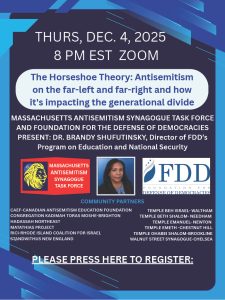
The Horseshoe Theory: Antisemitism on the Far-Left and Far-Right and How it’s Impacting the Generational Divide
Thursday, December 4, 8:00 pm ET
(online program presented by the Massachusetts Antisemitism Synagogue Task Force)
YAD CHESSED

Yad Chessed helps Jewish individuals and families who struggle with financial hardship pay their bills and buy food. As a social services agency rooted in the Jewish values of kindness (chessed) and charity (tzedakah), they are committed to helping those in need navigate a path toward financial stability while preserving their privacy and dignity. They provide emergency financial assistance, grocery gift cards and compassionate advice for those trying to make ends meet. Hundreds of families and individuals throughout the state rely on Yad Chessed to provide for their essentials, and even at times, a Jewish burial for a loved one. Members of our community, as well as others in the Jewish community, who need assistance may contact Yad Chessed by phone at 781-487-2693 or by Email at intake@yadchessed.org for a confidential conversation. Questions can be directed to info@yadchessed.org.
Support Yad Chessed